
DMX vs Art-Net vs sACN: Lighting Control for Large Buildings

Choosing between DMX vs Art-Net vs sACN is one of the most important decisions on any large lighting project, and it is usually made by people the owner never meets. The control protocol decides how many lights a building can run, how far the signal can travel, how fast a fault can be found, and whether the system can grow next year. On a hotel facade, an office tower crown, an arena concourse, or a theater marquee, the wrong choice shows up as flicker, dead sections, and expensive service calls.
This owner's guide explains the three protocols in plain language, shows where each one fits, and walks through how the WDM Lighting project team designs control systems for big buildings, including the networked Ethernet-to-DMX system we installed on the Lorenzo Hotel in Dallas. If you own, develop, or manage a large property, it will help you ask better questions before you sign a lighting scope.
DMX512 is the wired control signal that lighting fixtures actually understand. Art-Net and sACN are ways of carrying many DMX "universes" over a standard Ethernet network. Small systems can run on DMX alone; large buildings almost always use a network backbone (Art-Net or sACN) feeding Ethernet-to-DMX gateways near the lights.
- DMX512: 512 channels per universe, one universe per cable run, about 32 devices per line segment
- Art-Net: DMX over Ethernet, up to 32,768 universes, very widely supported by controllers and nodes
- sACN (ANSI E1.31): ESTA standard, up to 63,999 universes, multicast and source priority, well suited to very large systems
- For big buildings: a network backbone plus zoned gateways is the most reliable and serviceable design
What DMX512 is, and why it still matters
DMX512 is the industry-standard control protocol for architectural and entertainment lighting. It was created for theaters, and it is still the language most color-changing fixtures, drivers, and decoders speak. A DMX controller sends a continuous stream of data down a cable. That stream is divided into 512 channels, and each channel carries a value from 0 to 255, such as the brightness of red, green, or blue on a fixture. A full set of 512 channels is called a universe.
DMX runs on the RS-485 electrical standard. In practice that means a few hard rules every lighting contractor should respect:
- Daisy-chain topology: the signal travels from device to device in a line, not in a star.
- About 32 devices per line segment: RS-485 allows 32 unit loads per segment, so longer chains need splitters or boosters.
- Distance: runs of roughly 300 meters (about 1,000 feet) are commonly reliable with proper data cable and termination.
- Termination: the last device on every line needs a 120-ohm terminating resistor to stop signal reflections.
- Correct cable: 120-ohm data cable (or suitable Cat5e/Cat6 for many architectural products), never random microphone or speaker wire.
For a small lobby feature or a single sign, plain DMX from one controller is fine. The problem is scale. A modern pixel-mapped facade can use dozens or hundreds of universes. Running each one as a separate long cable from a basement controller to the roof is costly, hard to troubleshoot, and fragile.
How many lights fit in one DMX universe?
It depends on how many channels each light uses. A simple RGB pixel needs 3 channels, so one universe can control about 170 RGB pixels. An RGBW pixel uses 4 channels, so about 128 pixels per universe. Zone-controlled fixtures, where a whole run changes color together, use far fewer channels. That math is why large media facades and pixel-mapped buildings jump from one universe to dozens very quickly.
What Art-Net and sACN are: DMX over a network
Art-Net and sACN do not replace DMX at the fixture. Instead, they carry DMX data across a standard Ethernet network, the same kind of switches and cabling used for computers. At the end of the network, an Ethernet-to-DMX gateway (also called a node) converts the network data back into DMX lines that feed the lights nearby.
This changes the design of a big system completely. One control computer or lighting controller can talk to many gateways spread around the building over a single network. Each gateway serves a defined zone, such as a floor, a facade face, a tower crown, or a marquee.
Art-Net
Art-Net is a royalty-free protocol that sends DMX over UDP on Ethernet. It is supported by a very wide range of lighting consoles, media servers, pixel-mapping software, and gateways, which makes it a common choice on architectural and entertainment projects. Current versions address up to 32,768 universes. Art-Net can use broadcast or unicast traffic; on large networks, good design uses unicast so devices only receive the data they need.
sACN (Streaming ACN, ANSI E1.31)
sACN is the standard published by ESTA as ANSI E1.31. It supports up to 63,999 universes and uses multicast, so each gateway subscribes only to the universes it needs. It also supports source priority, which lets a backup controller or an event console take over specific zones cleanly. On very large or mission-critical systems, those two features make sACN attractive, especially when the network is shared with other building systems and managed by IT.
| DMX512 | Art-Net | sACN (E1.31) | |
|---|---|---|---|
| What it is | Wired serial control signal | DMX carried over Ethernet | DMX carried over Ethernet |
| Universes | 1 per cable run | Up to 32,768 | Up to 63,999 |
| Cabling | Daisy-chained data cable, about 32 devices per segment | Standard Ethernet switches and Cat5e/Cat6 or fiber | Standard Ethernet switches and Cat5e/Cat6 or fiber |
| Traffic | One-way stream | Broadcast or unicast | Multicast (subscribe per universe) |
| Redundancy / priority | Not built in | Limited | Source priority for backup or override |
| Best fit | Small features, single signs, the last run to fixtures | Multi-universe facades, venues, pixel mapping | Very large, multi-controller or IT-managed systems |
In real projects, the answer is rarely "one or the other." A typical large building uses a network protocol for the backbone and DMX for the final run from each gateway to its fixtures. The design question is where the network ends and DMX begins, and how the system is split into zones.
Which control system fits your building?
Here is how we think about it on project-scale work. These are general guidelines, and every building gets its own design.
| Project Type | Typical Lighting | Usual Control Approach |
|---|---|---|
| Hotel facade and signage | Linear LED lines, wall washers, illuminated name | Network backbone with zoned Ethernet-to-DMX gateways, scheduled scenes |
| Office tower crown / skyline lighting | Floodlights, linear grazers, pixel lines at the top floors | Gateways near the roof, network to a controller in a protected room |
| Arena or stadium exterior and concourse | Facade pixels, ribbon features, concourse color | Large multi-universe sACN or Art-Net network, often with show control |
| Theater or venue marquee | Chaser lights, pixel signage, canopy lighting | Art-Net or DMX depending on size, with event scenes |
| Mixed-use and retail development | Facades, landscape, canopies, signage across several buildings | Site-wide network with gateways per building or zone |
| Single lobby or amenity feature | Accent, cove, or fiber optic feature | Standalone DMX controller or small DMX system |

Real example: the Lorenzo Hotel control upgrade
The Lorenzo Hotel project at 1011 S. Akard Street in Dallas is a good illustration of why a network backbone matters. The hotel's signature look is a set of tall vertical light lines on the facade. To bring the system under reliable control, the WDM Lighting project team installed:
- Eight Ethernet-to-DMX gateways, splitting the facade into zones fed over a network
- IP-rated outdoor Cat5e data cable built for exposure to the elements
- 120-ohm terminating resistors on the DMX lines to prevent reflections and flicker
- Four TCP/IP-controlled circuit breakers, so facade power can be switched and reset over the network
- Addressing with a dedicated DMX writer, then full programming and commissioning
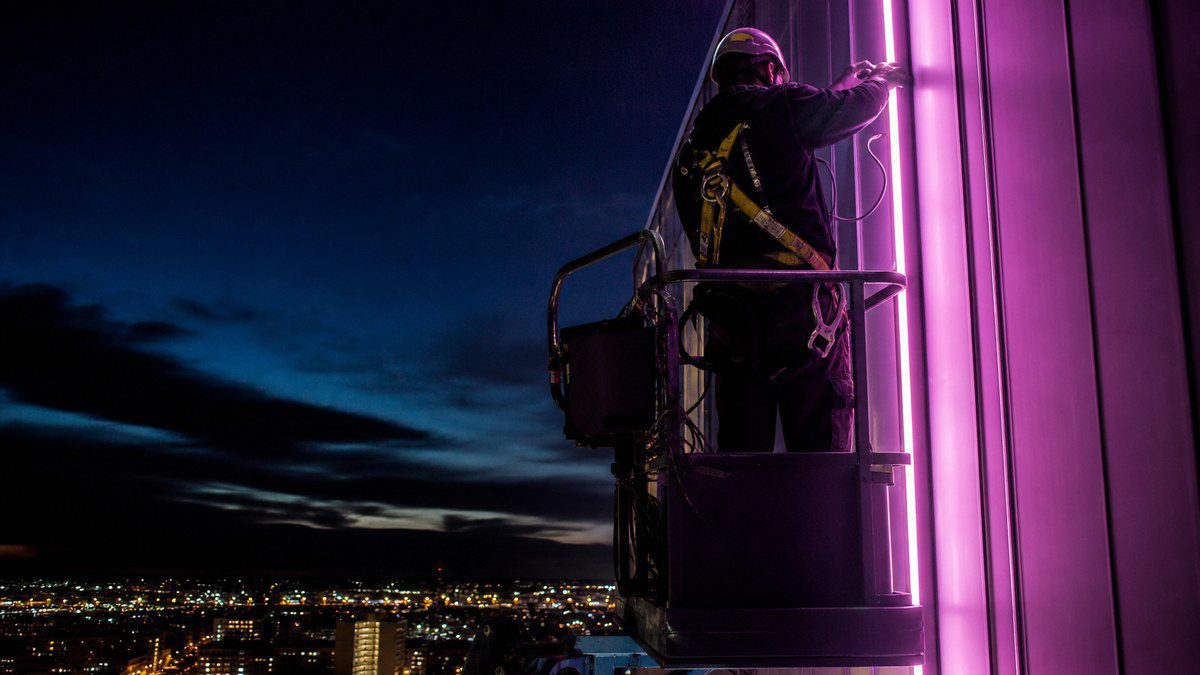
The high-point work was done with articulating boom lifts reaching 135 to 150 feet plus a two-person rope-access crew at nine locations, where new connections were soldered and sealed. The project was estimated in February 2026 and completed in March 2026, with technicians on site for one week.
The lesson for owners: a facade that used to depend on a few long, fragile runs now behaves as one networked system split into serviceable zones. When something needs attention, the team can isolate it by gateway and often reset power remotely instead of mobilizing a lift.
Planning a facade, venue, or tower lighting system?
Tell us about the building. Our project team will review the scope, recommend the right control architecture, and follow up with a project-specific proposal.
How we design control for large buildings
Protocol choice is only one part of a reliable system. These are the design decisions that matter most on big projects.
1. Zone the building
We divide the lighting into logical zones, such as each facade face, each floor band, the crown, and the signage. Each zone gets its own gateway or gateway port. One failure then affects one zone instead of the whole building, and a technician knows exactly where to look.
2. Put gateways close to the lights
Ethernet (or fiber for longer distances) handles the long haul from the control room. Gateways sit near the fixtures, so the DMX runs stay short, well inside the distance and device limits, and easy to terminate correctly.
3. Use outdoor-rated, sealed infrastructure
Exterior data cable must be rated for UV, heat, and moisture. Every outdoor joint is soldered, heat-shrunk, and sealed. Most "dark section" problems on facades start with water in a connection, not a failed LED.
4. Build in remote power control
Network-controlled breakers or relays let the owner's team or the service provider restart a zone without going on site. On a high-rise, that can save a lift mobilization.
5. Plan addresses and document everything
Every fixture, decoder, and pixel controller gets an address that matches a written universe and channel plan. Good documentation is what makes a system serviceable five years later by any qualified technician.
6. Keep the lighting network separate
Lighting traffic, especially at high universe counts, should run on its own switches or on a properly segmented VLAN coordinated with building IT. This protects both the lighting and the building network.
7. Choose the right controller
Simple schedules and color scenes can run from a compact architectural controller. Event looks, pixel mapping, and video content need a playback controller or media server. We match the controller to how the owner will actually use the building, not to the biggest box on the market.
Ask your lighting contractor for a one-page control riser: where the controller lives, how many gateways there are, which zones each one feeds, and how power can be reset. If nobody can draw it, the system will be hard to service.
Common control problems and what causes them
| Symptom | Likely Cause | Typical Fix |
|---|---|---|
| Flicker or random colors on a long run | Missing or wrong termination, poor cable, too many devices on one line | Add 120-ohm termination, correct cable, split the line with a splitter or new gateway |
| One section dark after a storm | Water in an outdoor connection or a failed power supply | Repair and seal the connection, replace the supply, check upstream data |
| Section shows the wrong scene | Addressing conflict or a replaced controller with default address | Re-address with a DMX writer and update the address plan |
| Whole facade stops responding | Controller, network switch, or power issue at the head end | Check controller and switch, reset power remotely if possible |
| Lag or stutter on pixel effects | Network congestion or broadcast traffic on a busy network | Use unicast Art-Net or multicast sACN, segment the lighting network |
If your building already shows some of these symptoms, a lighting performance audit is the fastest way to find out whether you need repairs, a control upgrade, or both. Very often an existing facade can be brought back with targeted fixes and new gateways rather than a full replacement.
Upgrading an older system to networked control
Many large buildings still run on a single standalone DMX controller installed years ago. The good news is that you rarely need to replace the fixtures to get the benefits of a network. A typical upgrade path looks like this:
- Survey the existing system day and night: which zones work, which do not, and how the data and power are routed.
- Map the universes and addresses that already exist, and identify fixtures or decoders that need replacement.
- Install a network backbone and place Ethernet-to-DMX gateways near each zone.
- Repair and seal connections at height using boom lifts or rope access where required.
- Add remote power control for the facade circuits.
- Re-address, program, and commission the full system, then hand over documentation and scenes.
This is essentially the path the Lorenzo Hotel project followed. Our commercial lighting services team handles every step, from the first survey to ongoing service.
Hardware you will hear about on a control project
- Controller or playback unit: stores and runs scenes, schedules, and shows.
- Network switches: carry Art-Net or sACN traffic through the building.
- Ethernet-to-DMX gateways / nodes: convert network data into DMX lines near the lights.
- DMX decoders and drivers: turn DMX into power for LED tape and fixtures, such as a 32-channel DMX decoder.
- Splitters and boosters: extend DMX lines and isolate faults.
- DMX writer / addressing tool: sets addresses on pixel controllers and fixtures.
- Network-controlled breakers or relays: switch and reset power remotely.
- Wireless DMX and RF controllers: useful where cable cannot be run, such as an outdoor-rated DMX master RF controller.
WDM Lighting supplies control hardware alongside LED, illuminators, and fiber optic products. Browse the full catalog by product category.
What shapes the scope of a control project
We prepare project-specific proposals rather than price lists, because no two large buildings are the same. These are the main drivers of scope and budget:
| Factor | Why It Matters |
|---|---|
| Number of universes and zones | More pixels and zones mean more gateways, cable, addressing, and commissioning time |
| Building height and access | Boom lifts, rope access, permits, and sidewalk or lane closures |
| New install vs upgrade | Reusing existing fixtures with new control is often far more economical |
| Control features | Simple schedules vs event scenes, pixel mapping, or video content |
| Network requirements | Dedicated lighting network, fiber runs, coordination with building IT |
| Remote monitoring and power control | Network breakers and remote access reduce future service visits |
| Ongoing service | A maintenance plan protects the investment and keeps the building lit |
Questions to ask before you sign
- Which protocol will run the backbone, and why that one for this building?
- How many universes does the design use, and how much room is left to grow?
- Where will gateways be located, and how many zones does each one feed?
- How are outdoor connections made and sealed?
- Can power be reset remotely?
- Who programs the scenes, and who can change them later?
- Will we receive a control riser, address plan, and as-built documentation?
- Who services the system, and how do they reach the highest points?
For the design side, see our guides on choosing lighting for architectural spaces and the top trends in architectural lighting for modern buildings.
Why owners choose WDM Lighting for big projects
WDM Lighting is based at 150 Express Street in Dallas. On large buildings, the value is one accountable team for the whole job:
- Design and engineering of lighting and control architecture, from universe plans to gateway layout
- Supply of LED, control, and fiber optic products from our own catalog
- Installation and high-point access, including boom lifts and rope-access crews
- Programming and commissioning of DMX, Art-Net, and sACN systems
- Service and maintenance after handover
See the work in our projects, including the Lorenzo Hotel, Mosaic Dallas, and the Davis Building. Learn more about WDM Lighting, read more on the blog, or reach us through our contact page.

Frequently Asked Questions
What is the difference between DMX and Art-Net?
What is the difference between Art-Net and sACN?
How many lights can one DMX universe control?
How far can a DMX cable run?
What is an Ethernet-to-DMX gateway?
Which protocol is best for a building facade?
Why does my facade lighting flicker?
Can an old DMX system be upgraded to networked control?
Can building lighting be controlled and reset remotely?
How much does a lighting control upgrade cost?
Tell us about your project
Hotels, towers, venues, and large commercial buildings. Share a few details and our project team will follow up.
