
Arena & Stadium LED Lighting: One System, Inside and Out

Arena and stadium LED lighting is no longer just about putting enough light on the field. Today's venues light the facade that fans see from the highway, the plaza where they gather, the concourses where they buy food, the seating bowl that comes alive during intros, and the signage and marquees that sell every event. When those layers are designed and controlled as one system, a venue feels like a show from the parking lot to the last row. When they are bolted together piece by piece, owners end up with five controllers, three contractors, and a building that never quite looks the way the renderings promised.
This guide is written for venue owners, operators, facility directors, and developers planning a new arena, a stadium renovation, or an upgrade to tired exterior and concourse lighting. We break down every lighting layer in a modern venue, how control and programming tie them together, what it takes to install and maintain lighting high above a seating bowl or roofline, and how to plan budget and schedule around an event calendar. Throughout, we explain how the WDM Lighting project team works as one accountable team for design, supply, installation, high-point access, programming, and long-term service.
Arena and stadium LED lighting covers several systems that should work as one: competition (sports) lighting, the seating bowl and show effects, exterior facade and plaza lighting, concourse and hospitality spaces, and signage or marquee lighting. The best results come from a single control network and one team that plans the whole venue.
- Biggest wins: instant on/off, dynamic light shows, lower energy and maintenance, and a facade that markets every event
- Key decision: how all lighting layers share one control backbone (DMX over a network, Art-Net or sACN)
- Hardest part: access, because much of the work sits on catwalks, rooflines, and facades 100+ feet up
- Plan around: the event calendar, broadcast requirements, and a long-term service plan
The five lighting layers of a modern venue
Most arena and stadium projects fail to reach their potential for one simple reason: each lighting layer is bought, installed, and controlled separately. Before talking about fixtures, it helps to map the whole venue as layers that will eventually share one control system.
1. Competition (sports) lighting
This is the lighting on the court, ice, or field. It has to meet the requirements of the sport, the league, and any broadcaster. In North America, the Illuminating Engineering Society's recommended practice for sports and recreational area lighting (ANSI/IES RP-6) is the common reference, and college and pro leagues and broadcasters publish their own requirements for light levels, uniformity, color temperature, and color rendering. Competition lighting is typically engineered by sports-lighting specialists to those specs. What owners often miss is that modern LED sports fixtures can also be dimmed, switched instantly, and integrated into the venue's show control, which opens the door to light shows during intros, timeouts, and celebrations.
2. Seating bowl and show lighting
Color-changing fixtures around the bowl, under balconies, along fascia, and on catwalks turn the arena itself into part of the show. Light chases during player intros, team-color washes after a goal, and synchronized effects with music and video boards all live here. This layer is pure DMX territory: hundreds or thousands of addressable channels that need clean data and careful programming.
3. Exterior facade, roofline, and plaza
The building exterior is the venue's billboard. Linear LED lines tracing the roof, wall washers on cladding, color-changing columns at the entries, and plaza lighting where fans gather before doors open. A well-lit exterior can run team colors on game nights, partner colors for sponsors, and themes for concerts and community events. This is the same discipline we use on high-rise hotels, like the facade lighting project we completed at the Lorenzo Hotel in Dallas.
4. Concourses, clubs, and hospitality
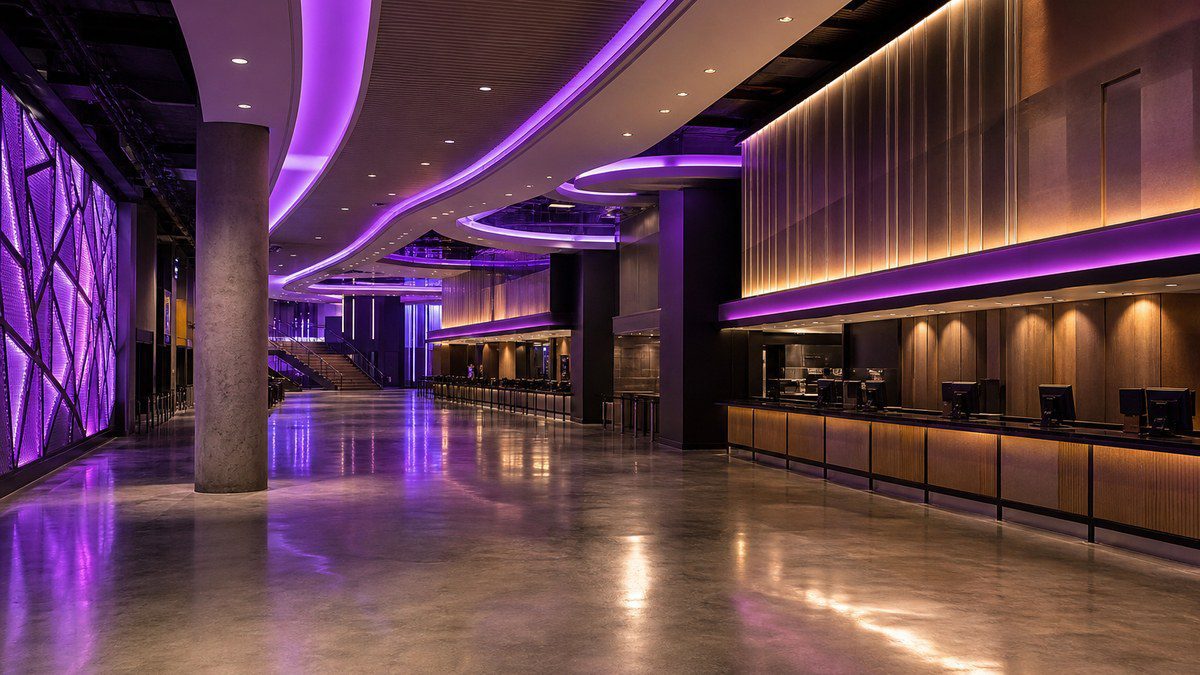
Concourses, premium clubs, suites, bars, and restaurants carry a large share of a venue's revenue. Lighting here has to be bright enough for wayfinding and safety, warm enough for hospitality, and flexible enough to switch between a hockey game, a concert, and a private event. Accent lighting, cove lighting, feature ceilings, and back-lit branding all belong in this layer.
5. Signage, marquees, and wayfinding
Entry marquees, illuminated letters, ribbon areas, and directional signage. LED video boards and ribbon displays are usually supplied by display specialists, but the lighting around them, and the control system that lets lighting and video run the same cues, is where a lighting team adds real value.
| Layer | Main Goal | Typical Fixtures | Control |
|---|---|---|---|
| Competition lighting | Meet sport, league and broadcast specs | High-output LED sports floodlights | Dedicated sports control, show-control integration |
| Seating bowl & show | Fan energy and event moments | RGB/RGBW fixtures, linear LED, moving lights | DMX over Art-Net or sACN, lighting console |
| Exterior facade & plaza | Brand the building, welcome fans | Linear LED, wall washers, floods, pixel lines | Networked DMX with schedules and event scenes |
| Concourses & hospitality | Wayfinding, safety, revenue spaces | Downlights, cove lighting, accent, feature ceilings | Dimming and scenes, often tied to building systems |
| Signage & marquees | Sell events, guide guests | LED letters, accent lighting around displays | Schedules, DMX, show-control triggers |
Why venues are moving to all-LED systems
Older arenas were built around metal halide sports lighting and static exterior floodlights. Metal halide lamps need a warm-up and cool-down period, which means lights stay on longer than they need to and can't be used for effects. LED changes the whole operating model:
- Instant on, instant off: lights respond immediately, so blackouts and reveals during intros are possible without waiting for lamps to restrike.
- Light shows: fixtures can be dimmed, colored, and sequenced, turning the venue lighting into part of the entertainment.
- Lower energy and heat: LED fixtures typically use far less power than the metal halide systems they replace and put less heat into the building.
- Less maintenance at height: long-life LED sources mean fewer trips to catwalks and rooflines to change lamps, which is one of the most expensive tasks in any venue.
- Better color and control: consistent color temperature and color rendering look better to fans in the seats and on camera.
- Sponsor and community value: an exterior that changes color for events, partners, and causes becomes a marketing asset instead of a utility bill.
For a broader look at what's shaping large-building design, see our article on the top trends in architectural lighting for modern buildings and our guide to choosing the right lighting for architectural spaces.
Control: the backbone that makes it one system
If there's one decision that determines whether a venue's lighting feels like one system, it's the control backbone. A modern arena can easily have tens of thousands of controllable channels across the bowl, facade, concourses, and signage. Running all of that from separate standalone controllers is a recipe for missed cues and long troubleshooting nights.
DMX at the fixture, network in the building
Most architectural and entertainment fixtures still speak DMX512, the long-standing control standard. One DMX universe carries 512 channels. To reach thousands of fixtures across a large building, venues carry lighting data over an Ethernet network using Art-Net or sACN (streaming ACN), then convert it back to DMX near the fixtures with gateways or nodes. We explain the differences in detail in our guide to DMX vs Art-Net vs sACN for large buildings.
Zoning the venue
A good control design splits the venue into logical zones: each facade elevation, the roofline, each concourse level, the bowl fascia, and the plaza. Each zone gets its own gateways and power, so a fault in one area doesn't darken the whole building. On the Lorenzo Hotel project, for example, the facade was brought under a network of eight Ethernet-to-DMX gateways with four network-controlled circuit breakers, so sections can be managed and reset remotely. The same principle scales up to a full arena.
Show control and integration
For game nights and concerts, the bowl lighting, competition lighting, and sometimes the exterior need to follow the same cues as the video boards and audio. That usually means a lighting console or show-control system that can trigger scenes across every layer. For day-to-day operation, facility staff need something much simpler: schedules, a handful of preset looks, and the ability to switch to an event theme without calling a programmer.
Remote monitoring and power
Network-controlled breakers and monitored gateways let the operations team see what's online and reset sections remotely. For a venue with fixtures on catwalks and rooflines, every avoided climb saves time, money, and risk.
Planning a venue lighting project or upgrade?
Tell us about your arena, stadium, or event venue. Our project team will review the scope and follow up with next steps and a project-specific proposal.
Exterior lighting: turning the building into a billboard
For many fans, the first impression of a venue is the drive in. A dark box with a few floodlights says nothing; a building wrapped in light says "something is happening here tonight." Exterior lighting for arenas and stadiums usually combines several techniques:
- Linear LED outlining: lines of light tracing the roof edge, canopy, columns, or structural ribs. Addressable lines can run chases and color effects.
- Wall washing and grazing: even washes of color across large cladding panels or textured walls, ideal for team colors.
- Pixel and media elements: pixel-mapped lines or panels that can show simple animations and graphics across part of the facade.
- Plaza and landscape lighting: color-changing columns, bollards, tree uplights, and gathering-space lighting that keeps fans safe and engaged before and after events.
- Entry and marquee lighting: lighting that frames the main entries, ticketing, and the venue name.
Exterior systems face the toughest conditions in the venue: UV, heat, storms, and moisture. That's why we specify outdoor-rated fixtures and cable, seal every outdoor connection, and terminate data lines correctly. These details are the difference between a facade that runs for years and one that develops dark sections after the first summer. Our article on facade lighting repair explains what goes wrong when those details are skipped.
Ask for a dedicated "event calendar" scene list during design. If your marketing team knows from day one that the exterior can run team colors, sponsor colors, holiday looks, and community themes on a schedule, the facade starts earning its keep immediately instead of sitting on one default color.
Concourses, clubs and suites: where lighting meets revenue
Concourse and hospitality lighting is often treated as basic building lighting, but it shapes how long guests stay, how much they spend, and how premium a club or suite feels. A few principles we apply on large commercial and hospitality projects carry straight over to venues:
- Layer the light. Combine general lighting for safety and wayfinding with accent lighting on menus, bars, art, and branding.
- Design scenes, not just levels. Pre-game, in-game, intermission, post-game, concert, and private event modes can each have their own look.
- Use feature elements. Back-lit walls, illuminated ceilings, and fiber optic or LED feature lighting in clubs create a premium feel. Our own catalog of fiber optic lighting and illuminators is often used for feature ceilings and accent details.
- Match the team brand. Accent lighting in team colors on game nights reinforces the identity without changing the architecture.
- Plan maintenance access. High concourse ceilings and atrium spaces need fixtures that can be reached and serviced without shutting down revenue areas.
Working at height: catwalks, rooflines and facades
Arena and stadium lighting lives in some of the hardest-to-reach places in any building: catwalks above the bowl, roof trusses, the top of the exterior facade, and canopy edges high above plazas. How crews reach those locations drives cost, schedule, and safety more than almost any other factor.
| Access Method | Where It's Used | Strengths | Considerations |
|---|---|---|---|
| Catwalks & truss access | Bowl lighting, sports fixtures, rigging points | Repeatable, built into the venue | Fall protection, coordination with rigging and events |
| Articulating boom lifts | Lower and mid facade, canopies, plazas | Fast for repeated work in one area | Ground space, surface loading, sometimes lane closures |
| Rope access (rappel) | Upper facade and roofline areas lifts can't reach | Minimal ground footprint, targeted repairs at many points | Certified anchorages, trained crew, weather windows |
| Scissor lifts & platforms | Concourses, clubs, interior ceilings | Stable work platform indoors | Floor loading, work around open revenue areas |
Our team combines these methods based on the building. On the Lorenzo Hotel in Dallas, crews used articulating boom lifts reaching 135 to 150 feet together with a two-person rope-access crew at nine high-point locations, soldering and sealing new connections at each point. That same blend of access planning, weatherproofing, and safety discipline is what large venues need on rooflines and facades. Federal rules also shape how rope descent work is done: OSHA's walking-working surfaces standard (29 CFR 1910.27(b)) generally limits rope descent systems to heights of 300 feet unless other access is infeasible or more hazardous, requires anchorages capable of supporting at least 5,000 pounds per worker, and requires the building owner to provide written certification of those anchorages.

Planning around the event calendar
Unlike an office tower, a venue can't simply close a floor for a few weeks. Lighting projects have to fit between home games, concerts, conventions, and community events. Good planning protects both the schedule and the revenue:
- Phase the work: exterior and plaza work can often run while the bowl stays in use; bowl and catwalk work fits into off-season windows or dark days.
- Lock in long-lead items early: custom fixtures, control hardware, and access equipment should be ordered as soon as the design is approved.
- Commission in stages: test and program each zone as it's finished so the venue never loses working lighting before a booked event.
- Leave time for programming: the show scenes are what fans remember. Programming and rehearsal time needs to be in the schedule, not squeezed in the night before opening.
- Coordinate with broadcast and display partners: competition lighting changes and show-control integration should be aligned with broadcasters and video board providers.
What drives the budget on a venue lighting project
Every arena and stadium is different, so we build project-specific proposals rather than price lists. These are the factors that move scope and budget the most:
| Budget Factor | Why It Matters | How to Control It |
|---|---|---|
| Scope of layers | Exterior only vs. exterior, bowl, concourse and signage | Phase layers over seasons with one control plan |
| Access and height | Lifts, rope access, catwalk time, closures | Plan access early and bundle work by location |
| Retrofit vs. new build | Existing wiring, mounting and controls may be reused | Audit what works before replacing it |
| Control complexity | Simple schedules vs. full show control and integration | Define the scenes and integrations you will really use |
| Fixture count and type | Addressable pixels need more channels, data and programming | Use pixel control where it adds value, zones elsewhere |
| Schedule constraints | Event calendar, off-season windows, overtime | Lock the schedule early and phase around events |
| Ongoing service | Keeping every section running season after season | Build a maintenance plan into the project |
For existing venues, the smartest first step is often a lighting performance audit. It shows what's working, what's failing, and where a targeted repair or control upgrade will deliver more than a full replacement.
Retrofit vs. new build: what changes
Retrofitting an existing arena
Many venues already have a mix of old metal halide sports lighting, static exterior floods, and a first-generation LED facade that's starting to fail. A retrofit project starts by documenting what exists: fixture types, circuits, data runs, controllers, and access routes. In many cases, existing power and mounting can be reused, and a new control backbone can bring older LED sections back under reliable control. The goal is to spend money where it changes the fan experience, not to replace equipment that still performs.
New venues and major renovations
On a new build or major renovation, lighting should be part of the design conversation early, alongside the architect, electrical engineer, and AV team. That's when it's cheapest to add conduit, data pathways, power for facade zones, mounting provisions, and maintenance access. Waiting until the building is nearly finished almost always costs more and limits what's possible.
How WDM Lighting runs a venue project
WDM Lighting is based at 150 Express Street in Dallas. On large projects, we act as one accountable lighting team from the first site visit to the final scene, and we coordinate with the sports-lighting engineers, display providers, and AV teams who own their parts of the venue:
- Site review and night survey: we walk the venue day and night to see how the lighting performs and where access will be difficult.
- Design and engineering: lighting layouts, control architecture, zoning, and integration with show control and building systems.
- Supply: fixtures, control hardware, and materials from our own catalog and trusted manufacturers, including DMX products such as our 32-channel DMX decoder and outdoor-rated DMX master controller.
- Installation and high-point access: crews on lifts, catwalks, and rope access, with outdoor connections soldered and sealed.
- Programming and commissioning: addressing, scenes, schedules, and event looks your team can run day to day.
- Service and maintenance: ongoing support so every zone keeps performing season after season.
See our work on the projects page, including the Lorenzo Hotel facade, Mosaic Dallas, and the Davis Building, or learn more about WDM Lighting. You can also read more guides on our blog.

Venue owner checklist before you start
- List every lighting layer you want to improve now and in the next five years, even if you phase the work.
- Gather drawings and as-builts for electrical, data, and existing lighting controls.
- Note the event calendar and the windows when bowl, facade, and concourse work is possible.
- Define the looks you want: game night, concert, sponsor, holiday, and everyday scenes.
- Confirm who owns what: sports lighting, video boards, audio, and lighting control, and how they will share cues.
- Plan access and safety: catwalk rules, lift locations, roof anchorages, and closures.
- Budget for service: a maintenance plan protects the investment and the fan experience.
Frequently Asked Questions
What does arena and stadium LED lighting include?
Why are arenas switching from metal halide to LED lighting?
Can sports lighting be part of an arena light show?
What standards apply to sports lighting in arenas and stadiums?
How is lighting controlled across a large venue?
Can an arena's exterior lighting change for different events?
How do crews install and maintain lighting high above a seating bowl or roofline?
Can an existing arena's lighting be upgraded instead of replaced?
How much does arena or stadium LED lighting cost?
Does WDM Lighting work on venue projects outside Dallas?
Tell us about your project
Hotels, towers, venues, and large commercial buildings. Share a few details and our project team will follow up.
