
Office Tower Crown Lighting: Owning the Skyline at Night
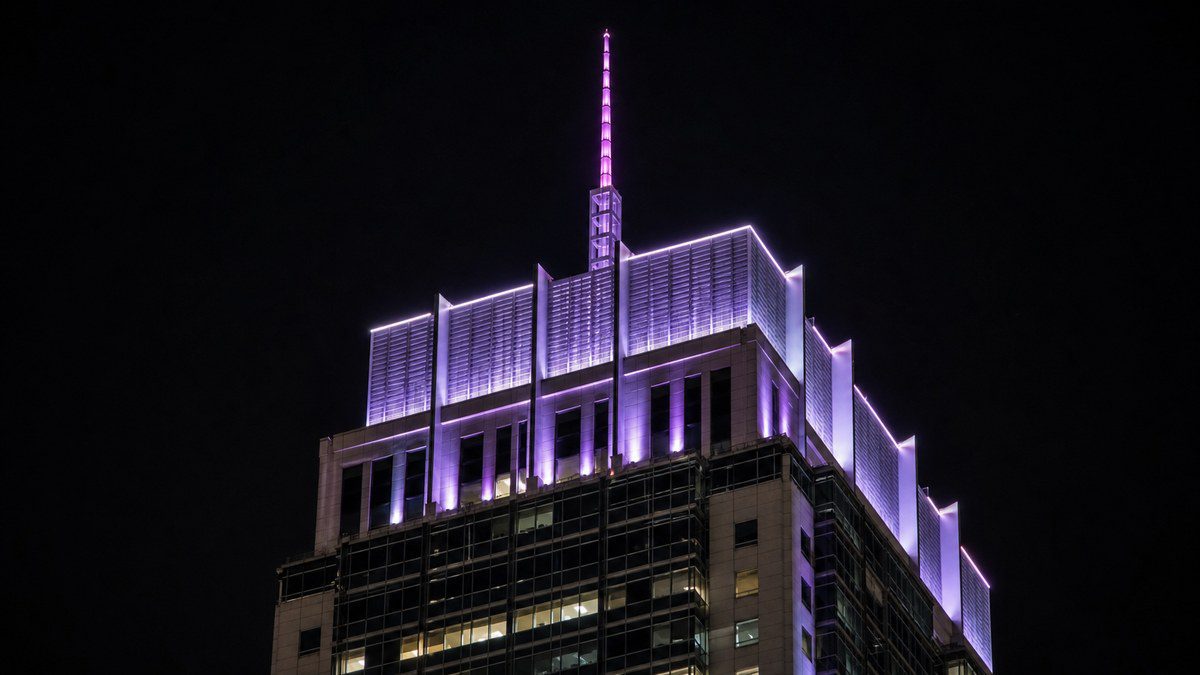
Office tower crown lighting is the lighting at the very top of a high-rise: the parapet, the mechanical screen, the spire or the sculpted roofline that people see from miles away. Done well, it turns a building into a landmark and a signature on the skyline. Done poorly, it leaves a dark, patchy top that tells the whole city something is not being looked after.
This guide is written for building owners, asset managers, developers, architects and chief engineers who are planning a new crown, upgrading an old floodlit top to LED, or trying to rescue a color-changing crown that no longer works. We cover the main design approaches, how crown lighting is controlled, what it really takes to install and service lighting at the top of a tower, the rules and neighbors you need to plan around, and how a large crown or skyline lighting project runs from first site walk to the first night it shines.
Office tower crown lighting is architectural lighting mounted at the top of a high-rise to define its silhouette at night. Most modern crowns use outdoor-rated LED wall washers, floodlights and linear lines on a networked DMX control system, so the building can run white light most nights and color scenes for events.
- Main approaches: wall washing and grazing, floodlighting from setbacks, linear LED outlines, pixel or media crowns, and spire or beacon accents
- Control: schedules and astronomical clocks for daily use, networked DMX for color scenes and events
- Planning items: viewing distance, glare and light trespass, aviation obstruction lights, migratory-bird dimming, wind and waterproofing
- Access: roof work, cranes or boom lifts on lower setbacks, and rope access for faces you cannot reach any other way
- One team: design, supply, installation at height, programming and ongoing service
What counts as the crown of a building?
On most office towers, the "crown" is everything above the last occupied floor. That usually includes one or more of these elements:
- The parapet and roof edge: the line where the facade meets the sky, often the cleanest place to trace the building outline in light.
- Mechanical screens: the louvered or glazed walls that hide cooling towers and equipment. They are often the largest surface at the top and a natural canvas for wall washing.
- Setbacks and terraces: stepped levels near the top that give you mounting positions to light the floors above.
- Spires, masts, fins and sculptural tops: the features architects add specifically to be seen from a distance.
- Building signage: tenant or building names near the top, which need to read clearly without fighting the rest of the lighting.
Crown lighting is usually one part of a wider architectural lighting scheme that may also include the lobby, the entry canopy, the plaza and the full facade. The best results come when all of those layers are designed as one system, even if they are built in phases.
Why owners light the top of a tower
A crown is an investment, so it helps to be clear about what it is meant to do. The reasons owners give us most often are practical, not just aesthetic:
- Identity and recognition. A distinctive top makes the building easy to name and easy to find. In a crowded skyline, it is how people tell one tower from the next.
- Leasing and positioning. A well-lit, well-maintained crown signals a cared-for, premium property to prospective tenants and their visitors.
- Marketing moments. A color-capable crown can run team colors on game night, holiday looks, awareness causes or a tenant's milestone, which gets the building photographed and shared.
- Civic presence. Many cities expect tall buildings to contribute to the night skyline. A thoughtful crown is part of being a good neighbor downtown.
- Replacing an old system. Many towers still have aging metal halide floods or early LED systems that are hard to service. An upgrade cuts energy and maintenance and brings back full output.
Well-known examples show what is possible. New York's Empire State Building, for example, moved its tower lights to a programmable LED system in 2012, allowing millions of color combinations and scheduled light shows. Most office towers do not need that scale, but the same principle applies: a crown that can change becomes a communication channel for the building.
Five ways to light an office tower crown
Most crowns use a combination of the approaches below. The right mix depends on the architecture, the viewing distances and how much the owner wants the crown to change from night to night.
| Approach | What it looks like | Best for | Typical control |
|---|---|---|---|
| Wall washing and grazing | Smooth glow across a surface, or light that skims texture and fins | Mechanical screens, stone, metal panels, vertical fins | Zoned DMX, white or color-changing |
| Floodlighting from setbacks | Broad light thrown up onto the floors above | Stepped tops, spires, large flat faces | Scheduling and dimming, sometimes color |
| Linear LED outlines | Crisp lines that trace the roof edge, corners or fins | Defining the silhouette from a distance | DMX by zone or pixel |
| Pixel or media crown | Animated color and graphics across the top floors | Landmark and entertainment buildings | Networked pixel mapping |
| Spire and beacon accents | A single glowing feature at the very top | Masts, spires, sculptural tops | Scheduling, DMX |
Wall washing and grazing
Wall washers are the workhorse of crown lighting. Mounted at the base of a mechanical screen or along a setback, they throw an even wash of light up the surface. Moved closer to the wall, the same type of fixture becomes a grazer that picks out texture, fins and mullions. Choosing the right beam angle matters a great deal at the top of a tower, because the surface may be tall and the mounting depth shallow. Narrow optics push light further up a tall screen; wider optics cover short, broad surfaces evenly.
Floodlighting from setbacks
Where a tower steps back near the top, each terrace becomes a mounting position for floodlights aimed at the floors above. This can produce a dramatic layered effect, but it needs careful aiming and shielding so that light lands on the building, not in the sky or in neighbors' windows.
Linear LED outlines
Continuous LED lines along the parapet and corners read cleanly from miles away and keep the building's shape recognizable even in haze. They are also the approach most exposed to weather, so connections, cable entries and mounting details have to be built for years of sun, wind and rain.
Pixel and media crowns
A pixel crown lets every point of light be controlled individually, so the top of the building can play animations, gradients and graphics. It is the most expressive option and the most demanding on data and control. Large pixel counts quickly add up to many DMX universes, which drives the number of gateways, the network design and the commissioning effort. Our guide to DMX vs Art-Net vs sACN explains how that data is carried on large buildings.
Spire and beacon accents
A spire or mast is often the single most visible element of a tower. Lighting it may be as simple as a few well-aimed floodlights or as involved as a fully color-changing feature that ties into the rest of the crown.
Designing a crown that reads from miles away
Design for the real viewing distances
A crown is seen from three very different places: the street directly below, nearby buildings and highways, and the far skyline view from across the city. Lighting that looks bold up close can disappear at a distance, and detail that reads well from a neighboring tower can turn to mush from the freeway. Good crown design checks each key view and decides which elements carry the identity of the building at each distance. Usually, strong outlines and evenly lit large surfaces carry best from far away.
White most nights, color when it counts
Many owners choose a crown that runs a refined white look on most nights and switches to color for events and holidays. Tunable-white and RGBW fixtures make that possible from one set of hardware. Picking the white carefully matters: a warm white can flatter stone and bronze, while a cooler white can suit glass and metal. A mock-up on the roof at night is the most reliable way to decide.
Glare, light trespass and neighbors
Light that spills past the building wastes energy and can bother neighbors, hotel guests and residents in nearby towers. Shielding, louvers, accurate aiming and the right optics keep the light on the architecture. This is also where local lighting ordinances, landlord rules and any downtown design guidelines come into play, so they belong in the design brief from day one.
Aviation obstruction lights
Tall buildings often carry aviation obstruction lights as required by the FAA, set out in the agency's advisory circular on obstruction marking and lighting. Architectural crown lighting must never block, wash out or be confused with those lights. Mounting positions, beam directions and colors near obstruction lights should be checked early with the building's engineering team.
Migratory birds and dimming schedules
Texas sits on one of the busiest bird migration routes in North America. Conservation groups and researchers behind Lights Out Texas, including the Cornell Lab of Ornithology, ask tall buildings to turn off or dim unnecessary lighting during peak spring and fall migration nights, and Dallas landmarks have dimmed their lights to take part. A modern control system makes this easy: the crown can follow a migration calendar automatically, dim or switch off after a set hour on forecast heavy nights, and come back to full output the rest of the year.
Planning a crown or skyline lighting upgrade?
Tell us about your tower. Our project team will review the building and follow up with next steps and a project-specific proposal.
Controlling crown lighting: schedules, scenes and remote power
The control system is what turns a set of fixtures into a crown that behaves. For a large tower, we usually design it in layers:
- Daily scheduling. An astronomical clock turns the crown on at dusk and dims or switches it off at the times the owner chooses, adjusting automatically through the year.
- Scene playback. A controller stores the white look, holiday scenes, team colors and special events, and plays them on a calendar.
- Networked DMX. Ethernet-to-DMX gateways carry control data from the head end up the building and split the crown into zones, so one fault does not take the whole top down.
- Remote power control. Network-controlled breakers let the team reset a section without sending someone to the roof.
- Access for the owner. Simple controls for the building engineer, with deeper programming handled by the lighting team.
This is the same control chain we used on our Lorenzo Hotel facade lighting project in Dallas, where we installed eight Ethernet-to-DMX gateways on IP-rated outdoor Cat5e, four TCP/IP-controlled circuit breakers, set addresses with a DMX writer and finished every data line with 120-ohm terminating resistors. Those details are what keep a tall lighting system stable and serviceable. For smaller zones, standalone hardware such as a 32-channel DMX decoder or an outdoor-rated DMX master RF controller can be part of the system.

Installing lighting at the top of a tower
The hardest part of most crown projects is not the lighting design. It is getting people, equipment and materials safely to the top of the building, and leaving the roof watertight when they are done.
Access methods
| Method | Where it works | Things to plan |
|---|---|---|
| Working from the roof | Parapets, mechanical screens, rooftop mounts | Fall protection, roof loading, protecting the membrane |
| Articulating boom lifts | Lower setbacks and podium levels; large units reach roughly 135–150 ft | Ground space, lane or sidewalk closures, permits |
| Rope access (rappel) | Vertical faces and spots no lift can reach | Certified anchorages, rescue plan, weather windows |
| Building maintenance units | Towers with a permanent gondola system | Owner coordination, BMU scheduling and load limits |
| Cranes | Heavy structures, large fixtures or new steel at the top | Lift plans, street closures, wind limits |
For rope access, U.S. federal rules matter. OSHA's rule for rope descent systems, 29 CFR 1910.27(b), generally limits them to heights of 300 feet or less unless other access is infeasible or more hazardous, requires anchorages that can support at least 5,000 pounds per worker, and requires the building owner to provide written certification of the anchorages, with annual inspection and recertification at least every 10 years. On a tall tower, that often means the access plan is a mix: work from the roof and the BMU where possible, lifts on the lower levels, and rope access for targeted points.
On the Lorenzo Hotel, for example, our crews used articulating boom lifts reaching 135 to 150 feet and a two-person rope-access crew at nine high-point locations, where new connections were soldered and sealed. We cover the same access decisions in our guide to facade lighting repair at height.
Mounting, wind and waterproofing
The top of a tower is the windiest, sunniest and most weather-exposed place on the building. Every crown project needs answers to a few hard questions:
- How are fixtures fixed? Clamps, rails or brackets that avoid new roof penetrations where possible, engineered for wind load.
- Where do penetrations go? Any new opening in the roof or parapet has to be detailed and sealed with the roofing team so the warranty stays intact.
- How does cable get up there? Routes through mechanical floors and risers, with outdoor-rated cable and drip loops wherever cable is exposed.
- Where do drivers and power supplies live? Ideally in a ventilated, accessible enclosure or plant room, not buried behind a screen that needs a crane to reach.
Specifying fixtures for a high-rise crown
| Item | What to look for | Why it matters at the top |
|---|---|---|
| Ingress rating | IP66 or higher for exposed exterior fixtures | Driving rain and pressure washing are normal at height |
| Optics | A choice of narrow to wide beams, with glare shielding | Lights tall surfaces evenly without spill into the sky |
| Color | RGBW or tunable white where the crown will change | One set of hardware for nightly white and event color |
| Mounting | Rated brackets, aiming locks, safety cables | Holds aim through wind and vibration for years |
| Finish and materials | Corrosion-resistant housings and hardware | Resists UV, heat and moisture |
| Control interface | DMX or networked control with clear addressing | Fast troubleshooting and future scene changes |
| Serviceability | Accessible drivers, sealed and documented connections | Cuts the cost of every future service visit |
Our commercial lighting services team specifies and supplies exterior architectural fixtures and controls, and can draw on our own catalog of products from across our range, including fiber optic lighting and illuminators for interior feature work in lobbies and amenity floors.

Retrofit, repair or start over?
Many towers already have crown lighting. The question is whether it can be saved. These are the three paths we usually see:
- Targeted repair. If the fixtures are sound but sections are dark, the cause is often water in connections, failed power supplies or a broken data chain. Fixing those points and upgrading controls can bring the crown back for far less than a new system.
- LED retrofit of an old floodlit crown. Replacing aging metal halide or early LED floods with modern LED fixtures cuts energy and lamp changes, and opens the door to dimming and color.
- New crown design. When the building is being repositioned, or the old system is beyond repair, a new design can rethink the whole top of the tower.
A night survey and a lighting performance audit are the right first step in each case. They show what is working, what is failing and why, so the scope is based on facts rather than guesses.
Ask for a full set of as-built drawings, addressing maps and control backups at handover. A crown with good documentation can be diagnosed in hours. One without it can take days of climbing and testing before any repair even starts.
Keeping a crown bright for years
Crown lighting lives in the harshest spot on the building, so it needs a plan, not just a service call when something goes dark. A sensible maintenance plan includes:
- Regular night surveys from key viewpoints to spot dark or off-color sections early.
- Head-end checks of controllers, gateways and network equipment, with configuration backups.
- Power supply and driver checks in their enclosures, before heat and age take them out.
- Aiming and mounting checks after major storms.
- Scheduled access windows combined with other roof work, so lift and rope-access days are used efficiently.
- Calendar updates for holiday scenes, events and migration dimming.
Our arena and stadium LED lighting guide covers the same thinking for big venues, where exterior facades and roof lines face the same weather and access challenges.
What shapes the budget for a crown project
Every tower is different, so we prepare project-specific proposals rather than price lists. These are the factors that move the scope most:
- Building height and access method: roof, BMU, lifts, rope access or cranes, plus permits and closures.
- Repair, retrofit or new design: reusing sound infrastructure can save a great deal.
- Lighting approach: white-only washing versus color-changing outlines or a full pixel crown.
- Number of zones and control points: more zones mean more gateways, cable and commissioning time.
- Structural and roofing work: new brackets, rails or penetrations and the coordination they need.
- Programming: a simple schedule versus a full calendar of scenes and events.
- Ongoing service: a maintenance plan protects the investment and keeps the crown looking right.
How a crown lighting project runs, start to finish
1. Site walk and night survey
We walk the roof and the crown by day, then view the building at night from the street and from the far skyline views. On existing systems we check power, data and physical connections and note where access will be difficult.
2. Design and mock-up
We develop the lighting concept, fixture layout and control plan, then test key fixtures on the roof at night so the owner and architect can see the light on the real building before committing.
3. Scope, access plan and schedule
A written scope lists every zone, fixture and control device, how each area will be reached, and how work fits around tenants, weather and other roof trades.
4. Supply and installation at height
Fixtures, controls, outdoor-rated cable and mounting hardware are staged before crews mobilize. Crews then install section by section, testing as they go, with connections sealed for the long term.
5. Programming, commissioning and handover
The system is addressed, programmed and commissioned as a whole. The owner's team gets working scenes, a schedule, documentation and simple controls, with WDM Lighting on hand for ongoing service.
Why owners choose WDM Lighting for tower lighting
WDM Lighting is based at 150 Express Street in Dallas and works on large lighting projects for hotels, office towers, venues and commercial buildings. On a crown project, one team handles the whole job:
- Design and engineering of crown, facade and control systems
- Supply of exterior LED fixtures, controls and accessories
- Installation and high-point access, including lifts and rope-access crews
- Programming and commissioning of DMX and networked control
- Service and maintenance after the lights are on
See how that works in practice in our Lorenzo Hotel case study, and browse other Dallas work including the Mosaic Dallas and the Davis Building on our projects page. You can also read about WDM Lighting, explore the top trends in architectural lighting for modern buildings, or browse more guides on our blog.

Frequently Asked Questions
What is office tower crown lighting?
Can crown lighting change colors?
How is lighting installed at the top of a skyscraper?
Does crown lighting interfere with aviation obstruction lights?
What is Lights Out Texas and does it affect building lighting?
Should we repair our old crown lighting or replace it?
What fixtures are used for building crown lighting?
How is crown lighting controlled day to day?
How much does a crown lighting project cost?
Does WDM Lighting work on towers outside Dallas?
Tell us about your project
Hotels, towers, venues, and large commercial buildings. Share a few details and our project team will follow up.
