
Wall Washing vs Grazing: Lighting Big Building Facades

Wall washing vs grazing is the first real decision on almost every large facade lighting project, and it shapes everything after it: which fixtures you buy, where they mount, how much the building glows from a block away, and how it looks to a guest standing at the front door. Get it right and a hotel, office tower, arena or mixed-use block reads as a clean, confident landmark at night. Get it wrong and the same building looks patchy, glary, or flat, and every flaw in the stone shows up the moment the lights come on.
This guide is written for owners, developers, architects and facility teams planning exterior lighting on big buildings. It explains the difference between washing and grazing in plain language, the rules of thumb designers use for setback and optics, how the facade material changes the answer, where fixtures actually mount on a high-rise, how to choose between color-changing and white light, and how a networked control system ties it all together. It also covers the part most guides skip: getting fixtures installed, aimed and serviced at height on an occupied building. That is where the WDM Lighting project team spends most of its time.
Wall washing sets fixtures back from the facade with wide optics so light lands evenly and the wall reads as one smooth, bright plane. Grazing mounts fixtures tight to the wall with narrow optics so light skims across the surface and every joint, rib and stone texture casts a shadow.
- Choose washing for smooth panels, painted or plaster surfaces, signage walls and anywhere you want even color and to hide surface imperfections.
- Choose grazing for stone, brick, ribbed precast, fluted columns and textured cladding you want to show off.
- Setback is the difference: interior guides commonly draw the line at about 12 inches from the wall; on big facades the right distance comes from a photometric study and a night mock-up.
- Glass is the hard case: reflective curtain wall does not wash well; light the mullions, fins, spandrels or the edges instead.
- Plan it as one system: fixtures, mounting, power, data, controls and access for service decided together, by one accountable team.
Washing, grazing, flooding: what each technique does
All facade lighting is about the angle at which light hits the surface. Change the angle and you change what the eye notices. Designers usually talk about four techniques on large buildings:
Wall washing
Fixtures sit back from the facade and use wide or asymmetric optics, so light arrives at a relatively open angle and spreads evenly. The result is a uniform glow with soft or no shadows. Washing makes a wall feel bigger and brighter, gives a clean field for color, and is forgiving of small surface flaws. It is the go-to technique for smooth metal panels, stucco, painted concrete, large signage walls and the flat bands of a tower crown.
Wall grazing
Fixtures sit very close to the facade and aim almost parallel to it, so light skims across the surface. Every protrusion catches light and every recess falls into shadow. Grazing is how you make limestone, brick, ribbed precast, board-formed concrete or a fluted column look dramatic and three-dimensional. It is unforgiving, though: a bowed panel, a patch repair or an uneven caulk line will show up just as clearly as the texture you wanted to reveal.
Floodlighting
Floodlights throw light from a distance, often from poles, neighboring roofs or the ground well away from the building. Floodlighting can illuminate a whole elevation, which is useful for historic buildings and large flat facades, but it is also where glare and light trespass become real issues if fixtures are not shielded and aimed carefully.
Accent and spot lighting
Narrow-beam spots pick out specific elements: a cornice, an entry canopy, a sculpture, the hotel name, a column capital. On most big projects, accents are layered on top of a wash or graze to create a clear focal point.
| Technique | Mounting | Typical Optics | The Look | Best Surfaces |
|---|---|---|---|---|
| Wall washing | Set back from the wall, or above/below a ledge | Wide or asymmetric (one guide cites roughly 40–60° beams) | Even, bright, flat field of light or color | Metal panel, stucco, painted concrete, signage walls |
| Wall grazing | Tight to the wall, at the base or top of the surface | Narrow (one guide cites under 30°), often linear | Strong texture, shadows, vertical drama | Stone, brick, ribbed precast, fluted columns |
| Floodlighting | Off the building: poles, roofs, ground | Medium to wide floods, shielded | Whole-elevation glow, classic monument look | Large flat or historic facades |
| Accent / spot | Ledges, canopies, ground, parapets | Narrow spot | Focal points and details | Entries, names, cornices, art |
For a broader look at how these techniques fit into a design, see our guide on choosing lighting for architectural spaces and our roundup of architectural lighting trends for modern buildings.
The rules of thumb: setback, optics and uniformity
Published guidance on washing and grazing comes mostly from interior lighting, where walls are 9 to 20 feet tall. The principles scale up to facades, but the exact numbers do not, so treat these as starting points rather than a recipe.
Setback: how far from the wall
Several manufacturer and trade sources draw the line between grazing and washing at roughly 12 inches: closer than that, light grazes; farther out, it starts to wash. One manufacturer application guide recommends about 6 inches for a grazer on a 9-foot wall and 24 to 30 inches for washers. Another guide suggests a wash setback of about one third of the wall height. The sources do not agree exactly, which is the honest answer: setback depends on the optic, the wall height and the effect you want.
On a facade that is 60, 200 or 600 feet tall, you cannot set a fixture back by one third of the height. Instead, large buildings are washed from ledges, setbacks, canopies, parapets and from the ground using asymmetric optics designed to throw light up or down a tall surface. The distance is worked out in a photometric calculation and then confirmed on the building at night.
Optics: beam shape matters more than wattage
The single biggest mistake on facade projects is choosing fixtures by lumen output alone. A powerful fixture with the wrong optic will hot-spot the bottom of the wall and leave the top dark, or throw light past the building into the sky. Washing usually calls for wide or asymmetric distributions that spread light along the wall while limiting spill. Grazing calls for narrow beams that travel up the surface. Many linear exterior fixtures offer several optics in the same housing, so the same product family can wash one elevation and graze another.
Uniformity: smooth vs dramatic
Designers measure how even a lit wall is by comparing the brightest and dimmest points. Washers are designed for low ratios, meaning smooth light from top to bottom. Grazers naturally produce higher ratios because light is brightest near the fixture and fades along the surface, which is part of the dramatic look. In one manufacturer's published photometrics on a 9-foot wall, the grazer's max-to-min ratio was roughly three times the washer's. On a tall facade, that gradient is often hidden by mounting grazers at both the base and the top, or by stacking fixtures at each floor ledge.
Always mock up washing and grazing on the real facade at night before ordering. A few test fixtures on a lift for one evening will tell you more about setback, optic and color than any rendering, and it is the cheapest change you will ever make to a big lighting project.
Match the technique to the facade material
The material decides more than the designer does. Here is how common big-building surfaces behave under light:
- Natural stone and limestone: the classic grazing surface. Grazing shows the grain and the joints and makes heavy masonry look carved. Washing works too when the stone is smooth-honed and you want an even glow.
- Brick: grazing exaggerates mortar joints and texture, which can look rich on a historic building or busy on a large modern wall. Many designers wash brick at a moderate angle as a compromise.
- Precast and architectural concrete: ribbed, fluted or board-formed precast is made for grazing. Flat precast panels wash cleanly, but grazing will show every panel joint and any color variation between pours.
- Metal panel and ACM: smooth, often semi-gloss. Washing gives a clean field; grazing reveals oil-canning (waviness) in thin panels, so test first.
- Stucco and EIFS: wash it. Grazing turns minor trowel marks and patch repairs into obvious flaws.
- Glass curtain wall: the hardest case. Glass and polished stone are specular, meaning they reflect the light source rather than glowing, and sources consistently flag them as difficult to illuminate. On glass towers, the answer is usually to light the frame instead: mullions, fins, spandrel panels, the crown or the building edges, often with linear LED or pixel lines. Our media facade and pixel mapping guide covers that approach.
Color matters too. Light, matte finishes reflect light well and need less energy to look bright. Dark finishes and polished surfaces need more light, tighter optics or a different technique altogether.

Where fixtures mount on a big building
On a high-rise or a long commercial facade, mounting locations are dictated by the architecture. A good lighting plan uses what the building already offers:
At the base: in-grade and surface-mounted fixtures
Linear grazers or wide washers set at the foot of the facade light upward. This is the simplest location to install and service, but it puts fixtures where people walk, landscape crews work and water collects. In-grade fixtures need proper drainage and sealed connections, and every upward-aimed fixture must be aimed so the light lands on the wall, not the sky.
On ledges, setbacks and floor bands
Many towers have horizontal ledges or setbacks every few floors. Mounting linear washers or grazers on each ledge lets you light a tall surface in stacked sections, keeping each fixture close enough to do its job. It also creates natural lighting zones that can be controlled separately.
At the parapet: down-washing and crown lighting
Fixtures at the roof edge aiming down keep light on the building and out of the sky, which helps with light trespass and dark-sky goals. Parapets are also where crown lighting lives, covered in detail in our office tower crown lighting guide. Parapet work means wind loads, roof access, fall protection and often rope access for anything below the edge.
Off the building: poles and neighboring structures
Floodlighting from poles or nearby roofs can light an elevation that has no mounting points. It is the fastest way to light a whole wall, and the easiest way to create glare for drivers, neighbors and hotel guests, so shielding and aiming are critical.
Keeping light on the surface
Exterior lighting on big sites increasingly has to meet local outdoor lighting rules. The DarkSky / IES Model Lighting Ordinance groups areas into lighting zones from LZ0 to LZ4, and many fixtures carry a BUG rating (backlight, uplight, glare) under IES TM-15. Upward wash and graze lighting is a deliberate exception that many jurisdictions treat carefully, so confirm the rules with your local jurisdiction early. Good practice is simple: aim light at the facade, shield the source, avoid throwing light past the roofline, and dim or switch off after a set curfew. We covered these site-wide rules in our mixed-use and retail exterior lighting guide.
Color-changing or white: choosing the light itself
Once the technique is set, the next choice is the light source. Large facades typically use one of four options:
| Light Source | What It Does | Best For | Watch Out For |
|---|---|---|---|
| Static white (single CCT) | One color temperature, dimmable | Stone, heritage buildings, corporate HQs | No flexibility for events or brand moments |
| Tunable white | Warm to cool white on demand | Hotels and towers that shift mood through the night | Color consistency between fixtures |
| RGB / RGBW / RGBA color | Full color, scenes, holidays, team colors | Hotels, arenas, entertainment venues, landmarks | Pastels and whites look off on RGB-only; RGBW or RGBA helps |
| Addressable pixel lines | Each segment controlled individually | Media facades, animated crowns, outlines | More data, addressing and programming |
Color consistency matters more on a big facade than anywhere else, because hundreds of feet of wall make small differences obvious. One industry guide recommends a color rendering index above 90 and tight two-step color binning for washing and grazing so neighboring fixtures match. When you are buying fixtures for a facade, ask for the color specification in writing and order spares from the same production run.
WDM Lighting supplies exterior architectural fixtures for both techniques, including ColorBlast floods, the ColorGraze MX4 linear grazer, the 49" ColorWash RGB wall washer, the ColorBlock RGB wall washer, the 72" high-power RGB wall washer and a 30 W LED floodlight for white accent and flood work. On a project, the fixture is chosen for the optic and the mounting first, then the brand and model.
Planning to wash or graze a big facade?
Send us your building, your elevations and what you want it to look like at night. Our project team will review it and follow up with next steps and a project-specific proposal.
Controls: turning fixtures into one facade
A wash or graze design is only as good as the system that runs it. On a large building, controls decide whether the facade can change color for an event, dim after midnight, run a holiday scene on a schedule, or be reset without sending a crew up the building.
- Zone the building: divide the facade into sections by elevation, floor band or architectural element, so each can be controlled and serviced on its own.
- Use a network backbone: Ethernet-to-DMX gateways carry commands over standard network cable and convert them to DMX near the fixtures. Our DMX vs Art-Net vs sACN guide explains the options in plain language.
- Address and terminate correctly: every fixture needs the right address, and long DMX runs need proper termination, or the facade will flicker and show wrong colors.
- Schedule it: evening, late-night, event and holiday modes on an astronomical clock, plus curfew dimming where local rules require it.
- Plan for remote resets: network-controlled power lets an operator restart a section without a site visit.
For smaller zones and retrofits, a 32-channel DMX decoder or an outdoor-rated DMX master RF controller can run color washers without a full network. On a large building, a networked system is usually worth it.
What we learned on the Lorenzo: details that keep a facade lit
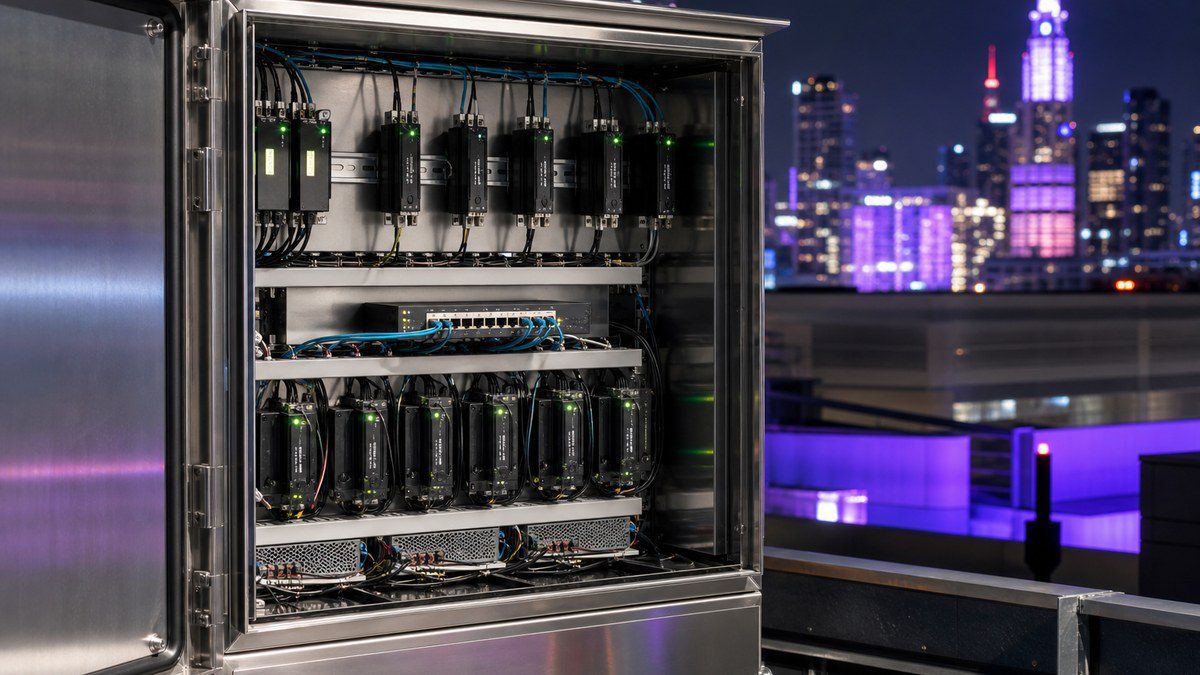
The same details that decide whether a facade looks right on opening night decide whether it still looks right three summers later. On our Lorenzo Hotel facade lighting project in Dallas, the work combined articulating boom lifts reaching 135 to 150 feet with a two-person rope-access crew at nine high-point locations, where new connections were soldered and sealed. The control side included eight Ethernet-to-DMX gateways on IP-rated outdoor Cat5e, four TCP/IP-controlled circuit breakers, a DMX writer for addressing, and 120-ohm terminating resistors on the data lines.
Those lessons apply directly to any wash or graze system:
- Seal every outdoor connection. Water in a joint is one of the most common reasons sections of a facade go dark.
- Use outdoor-rated data cable and protect it from UV and standing water.
- Terminate data lines so long runs do not flicker or drift in color.
- Zone with multiple gateways so one fault does not darken the whole building.
- Add remote power control to save service calls.
If your current facade lighting already has dark or flickering sections, our guide to facade lighting repair explains how to read the pattern and fix it at height, and a lighting performance audit is a good place to start.
Access and maintenance: the part that decides the budget
On large buildings, reaching the fixtures often costs more than the fixtures themselves. A wash or graze design should be planned with service in mind from day one:
- Boom lifts handle the lower and mid sections from the ground; large articulating units reach roughly 135 to 150 feet, but need space and sometimes a lane or sidewalk closure.
- Rope access reaches upper floors and parapets with a small footprint at street level. Under OSHA's rule for rope descent systems (29 CFR 1910.27(b)), use is generally limited to heights up to 300 feet unless other access is infeasible or more hazardous, anchorages must support at least 5,000 pounds per worker, and the building owner must certify the anchorages in writing.
- Fixture placement: fixtures on ledges and parapets that can be reached from the roof are far cheaper to service than fixtures in the middle of a sheer wall.
- Routine care: lenses on upward-aimed fixtures collect dirt, leaves and water; a yearly night inspection, lens cleaning and re-aiming after storms keep the wash even.
Which technique fits your building type?
| Building | Common Approach | Why |
|---|---|---|
| Hotel with stone or precast base | Graze the base, wash the upper floors, accent the entry and name | Texture up close for guests, clean glow from the street |
| Glass office tower | Light fins, mullions, spandrels and the crown; minimal wash | Glass reflects rather than glows |
| Arena or stadium | Color wash on solid cladding, pixel lines on edges, accent on entries | Event colors and a recognizable night silhouette (see our arena and stadium lighting guide) |
| Historic downtown building | Warm white grazing and floodlighting, shielded | Shows craftsmanship without looking theatrical |
| Theater or entertainment venue | Wash the facade, keep the marquee as the brightest element (see our marquee lighting guide) | The sign stays the hero |
| Mixed-use or retail block | Wash smooth panels, graze feature walls, accent storefronts | Variety along the street, consistent control |
Hotels in particular benefit from planning the facade alongside the lobby, ballroom and pool deck as one system, as we explain in our hotel lighting design guide.
What shapes the cost of a facade wash or graze project
Every building is different, so WDM Lighting prepares project-specific proposals rather than price lists. The main factors are:
- Facade size and height: how many linear feet of fixtures, how many floors and elevations.
- Mounting and access: base and ledge mounting is simpler than mid-wall mounting; lifts, rope access, permits and street closures all add up.
- White or color: RGBW and tunable fixtures, and addressable pixel lines, cost more and need more programming.
- Controls: a simple time clock, zone control, or a full networked system with scenes and remote power.
- New build or retrofit: reusing existing power and conduit can save a lot; working around an occupied building adds planning.
- Mock-up and design: photometric studies and a night mock-up are a small part of the budget and prevent expensive mistakes.
- Service: a maintenance plan protects the investment and keeps the facade even year after year.
How a facade lighting project runs with one team
1. Night survey
We walk the building day and night, photograph each elevation, note materials, existing fixtures, power, data routes and access, and check how the building is seen from the street and the skyline.
2. Concept and photometrics
We decide which surfaces to wash, which to graze, and which to leave dark, then select optics and mounting locations and run the calculations.
3. Night mock-up
Test fixtures go up on the real facade so the owner and architect can sign off on setback, color and brightness before anything is ordered.
4. Supply and engineering
Fixtures, brackets, drivers, gateways and outdoor-rated cable are supplied together, with power and data routes engineered for weather and for future service.
5. Installation at height
Crews install section by section using boom lifts and rope access, with every connection sealed and every section tested before the equipment moves.
6. Aiming, programming and handover
Fixtures are aimed at night, addressed and programmed with day-to-day, event and curfew modes. The owner's team gets documentation, a fixture and circuit map, training and a service plan.
That is the advantage of one team for design, supply, installation including high-point access, programming and service: nothing falls between contractors. See more of our work, including the Mosaic Dallas and the Davis Building, on our projects page, explore our commercial lighting services, learn about WDM Lighting, or read more guides on the WDM Lighting blog.

Frequently Asked Questions
What is the difference between wall washing and wall grazing?
How far from the wall should grazing and washing fixtures be?
Should I wash or graze a stone facade?
Can you wash a glass curtain wall with light?
Why does grazing make my facade look uneven?
Is color-changing or white light better for a building facade?
Does upward facade lighting cause light pollution?
How are wash and graze fixtures controlled on a big building?
How much does it cost to light a building facade?
Tell us about your project
Hotels, towers, venues, and large commercial buildings. Share a few details and our project team will follow up.
