
Fountain & Water Feature Lighting: Resorts, Plazas & Developments

Fountain lighting is where water, electricity and showmanship meet, and on a big project it is one of the hardest lighting jobs to get right. A resort entry fountain, a mixed-use plaza with dancing jets, a hotel atrium waterfall or a lake feature at the center of a new development all have the same job at night: turn moving water into the landmark people remember and photograph. When the fixtures fog up, the colors drift, half the jets go dark or the show falls out of sync, the whole feature looks neglected.
This guide is written for owners, developers, hotel and resort operators, landscape architects and general contractors who are planning or upgrading a large water feature lighting project. It covers how light actually travels through water, the main fixture types, the safety and code questions every commercial fountain must answer, how DMX control turns jets and lights into one show, and what it takes to keep a feature working for years. It also explains how the WDM Lighting project team handles design, supply, installation, programming and service as one accountable team.
Commercial fountain lighting uses sealed, submersible (IP68) LED or fiber optic fixtures placed below the waterline or inside nozzles to light jets, cascades and pools from within, run on a DMX or networked control system so color, brightness and water effects can be programmed as one show.
- Light from below: fixtures sit under the water or at the nozzle so the jet carries the light upward.
- Safety first: in the U.S., fountains fall under NEC Article 680 (Part V), including GFCI protection for submersible equipment unless it is listed low-voltage-contact equipment on a compliant supply.
- One control system: DMX addresses each light and can also cue pumps and valves, so water and light move together.
- Plan for service: scale, biofilm and failed seals are the usual reasons features go dark; access and maintenance must be designed in.
- One team: design, supply, install, programming and service from one contractor avoids finger-pointing between the fountain, electrical and lighting trades.
Why water features need a different lighting approach
Lighting a building facade and lighting a fountain look similar on a drawing, but they behave very differently in the field. On a facade, light travels through air and lands on a solid surface. In a fountain, the light has to work with water that is moving, aerated, changing level and constantly depositing minerals on anything it touches.
- Water is the screen. A clear, smooth jet can carry light up its length; a foamy, aerated jet catches light and glows white. The nozzle choice decides how the lighting reads.
- Fixtures live underwater. They must be sealed, corrosion-resistant and usually rely on the water around them to stay cool.
- People are close. Plaza fountains and splash pads invite touching and playing, which makes electrical safety and low-voltage design non-negotiable.
- The environment is harsh. Texas sun, chlorine or other treatment chemicals, hard water and storm debris all attack lenses, gaskets and connectors.
- It is part of a show. Many modern features choreograph lights, jets and sometimes music, so the lighting has to share a control system with pumps and valves.
That is why fountain projects need a lighting team that understands both architectural control systems and wet-location hardware, not just a fixture list.
How light travels through moving water
The most important idea in fountain lighting is simple: light the water from inside, not from the outside. Floodlighting a fountain from the edge mostly creates glare and reflections. Placing fixtures under the water surface, aimed up the jets or cascades, lets the water itself become the light source.
Clear laminar jets: light that rides the water
A smooth, glass-like jet behaves a little like fiber optic cable. Light that enters the stream at the nozzle reflects internally and travels along the arc, so the whole jet appears to glow and the light breaks out where the stream splashes down. The effect depends on a very smooth, bubble-free stream, which is why clean water and clean nozzles matter so much for this kind of feature.
Aerated and foam jets: light that glows white
Foam, cascade and aerated jets mix air into the water on purpose, making a thick white column. These jets scatter light instead of channeling it, so a fixture ring at the base turns the whole column into a glowing pillar of color. They are forgiving, very visible from a distance and popular for resort entries and big plazas.
Waterfalls, weirs and walls
Sheet waterfalls and water walls are lit from a linear fixture or a row of spots behind or below the lip so the falling sheet catches the light. A related option is a fiber optic waterfall curtain, which uses glowing fiber strands to create a "falling water" effect of light without moving water at all, ideal for lobbies, atriums and venues where real water is impractical.
Still water: pools, ponds and reflecting basins
Reflecting pools and lakes are about the surface, not the jets. Here the goal is often a soft glow or uplighting of nearby trees and architecture so the water mirrors it. Floating features, such as an illuminated floating fountain, put the light right at the center of a pond or lake; our LED floating fountain guide walks through the basics of that product type.
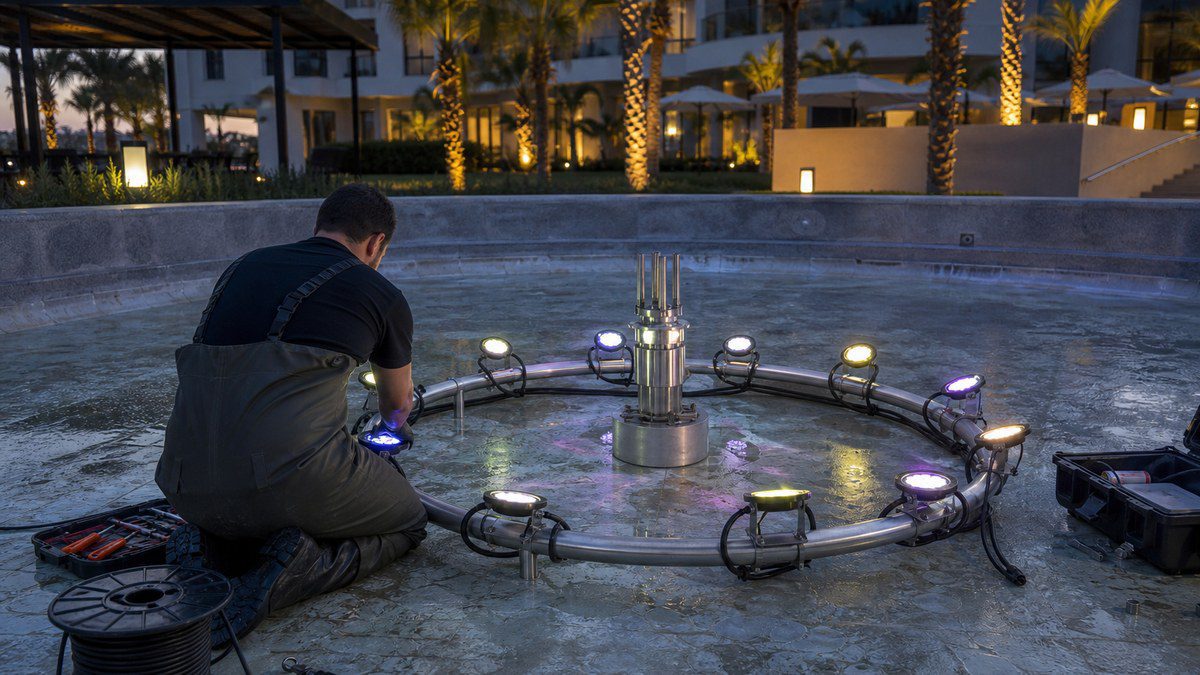
Fountain lighting fixture types compared
Most large water features combine several fixture families. The table below summarizes where each one fits.
| Fixture type | What it does | Best for | Watch-outs |
|---|---|---|---|
| Submersible LED spot / flood (IP68) | Uplights jets, cascades and sculpture from below the water | Resort and plaza fountains, lakes, basins | Must stay submerged or be listed for above-water use; lens needs regular cleaning |
| Nozzle ring lights | A ring of LEDs around a single nozzle lights the jet from its base | Feature jets, foam and cascade jets | Ring size must match the nozzle; seals and cables take a beating |
| Linear underwater LED | A continuous line of light along a weir, lip or edge | Water walls, sheet falls, infinity edges | Long runs need careful power and data planning |
| In-deck / dry-deck LED | Fixtures set flush in the paving around each jet | Interactive plazas and splash pads | Drive-over and walk-over rating, drainage and low-voltage design |
| Fiber optic (remote illuminator) | Light is made in a dry box and carried to the water by fiber; no electricity at the point of light | Pools, spas, ponds, sensitive or hard-to-reach spots | Lower output than direct LED for tall jets; illuminator needs a dry, ventilated location |
| Above-water accent and landscape lights | Lights sculpture, planting and architecture around the feature | Completing the scene at night | Glare control so guests are not looking into fixtures |
For pools, spas and ponds where keeping electricity away from the water matters most, WDM Lighting supplies fiber optic pool and spa lighting and fiber optic pond lighting, driven by our illuminators. For jets and lake features, LED products such as the high-power wide-angle LED fountain ring light and the LED floating fountain ring and pump kit show the kind of hardware involved, though large projects are always specified to the site.
Safety and code: the questions every commercial fountain must answer
Water and electricity are a serious combination, and commercial fountains are inspected accordingly. In the United States, the National Electrical Code (NEC) covers fountains in Article 680, which deals with swimming pools, fountains and similar installations, with fountains addressed in Part V. Exact requirements depend on the code edition your jurisdiction has adopted and on the authority having jurisdiction (AHJ), so treat the points below as the questions to ask your design team, not as a substitute for the engineering and inspection process.
- GFCI protection. Industry summaries of the NEC note that submersible equipment used with a fountain must be GFCI-protected, with an exception for equipment listed for low-voltage contact and supplied by a power source that meets the code's low-voltage requirements.
- Submerged lenses. Fountain luminaires are commonly cooled by the water around them, so the lens generally has to sit below the normal water level unless the fixture is listed for above-water locations.
- Low-water protection. Equipment that depends on being submerged for safe operation needs protection against overheating, such as a low-water cutoff.
- Bonding and grounding. Metal piping and equipment associated with the fountain must be bonded and grounded as the code requires; shortcuts here create shock hazards.
- Listed equipment. Fixtures, junction boxes and power supplies should be listed for the wet or submersible location they are used in.
On plazas and splash pads where children and the public can touch the water, low-voltage submersible fixtures, remote power supplies in a dry vault, and fiber optics wherever practical keep line voltage as far from people as possible. Settle the electrical strategy with the engineer of record and the AHJ before fixtures are selected, not after.
Code compliance is also why fountain lighting works best when the lighting contractor, electrician and fountain builder are coordinated from the first drawing. Our commercial lighting services team works alongside the project's licensed electrical contractor and engineer so the lighting design, power design and inspection plan line up.
Planning a water feature that has to shine every night?
Tell us about the fountain, plaza or development. Our project team will review it and follow up with next steps and a project-specific proposal.
Control: turning water and light into one show
A modern fountain is a lighting system and a mechanical system that have to act as one. The same control principles we use on building facades apply here, with one extra layer: the water.
DMX for the lights
Most color-changing fountain fixtures are controlled by DMX512, the industry-standard lighting protocol. Each RGB or RGBW fixture takes a small group of channels, so every jet's color and brightness can be set individually. On larger features, the DMX runs over a network using Art-Net or sACN and is split into zones with gateways, exactly as on a big facade. Our guide to DMX vs Art-Net vs sACN explains how those layers fit together, and decoders such as our 32-channel DMX decoder are the kind of hardware that converts the control signal for LED fixtures.
Pumps and valves on the same timeline
In choreographed fountains, the controller also cues the water. Solenoid valves switch jets on and off quickly for sharp effects, while variable frequency drives (VFDs) ramp pump speed so jets rise and fall smoothly. When lights and water are programmed on one timeline, a jet can "launch" in white, peak in violet and fade as it drops, instead of the lights cycling colors with no relationship to the water.
Scenes, schedules and modes
Operators rarely need a full show every minute. A practical control design gives them a handful of modes:
- Day mode: water only, lights off.
- Evening ambience: slow, warm or brand-color scenes that complement the facade and landscape.
- Show mode: scheduled choreographed shows on the hour or for events.
- Event and holiday looks: team colors, holiday palettes or a client's brand color for a private event.
- Wind and safety modes: reduced jet height or shutdown in high wind, linked to sensors, so guests and paving stay dry.
Tying the fountain into the same network as the building's exterior lighting lets the whole property change looks together. That is the same "one system" approach we describe in our hotel lighting design guide and in our work on media facades and pixel mapping.

Where big water features are going
| Setting | Typical feature | Lighting priorities |
|---|---|---|
| Resorts and casinos | Entry fountains, lagoons, choreographed shows | Maximum visibility, show programming, brand colors, robust service plan |
| Hotels | Porte-cochère fountains, pool decks, atrium waterfalls | Guest comfort, glare control, coordination with facade and lobby lighting |
| Mixed-use and retail developments | Plaza jets, dry decks, water walls | Public safety, low voltage, durability, event modes |
| Corporate campuses and office towers | Reflecting pools, entry walls | Calm architectural scenes, energy-efficient schedules |
| Parks, civic spaces and lakes | Floating fountains, large jets, splash pads | Long throw, vandal resistance, simple operation for staff |
Interactive plazas and dry decks
Dry-deck or "splash plaza" fountains place the jets flush in the paving, with water draining through grates into a tank below. Manufacturers describe them as a play space by day and a show by night, with a light at each jet so every jet can be lit independently. Because people walk and play directly over the fixtures, they demand walk-over rated hardware, low-voltage power, careful drainage, automated water treatment and control logic that can pause the feature when needed.
Lakes and ponds at the center of a development
Many new developments use a lake or pond as the centerpiece. A large floating fountain with ring lights gives a strong focal point visible from roads and balconies, while shoreline uplighting and illuminated bridges or docks complete the scene. Access is by boat or from the shore, so fixtures and cabling must be planned for removal and service.
Indoor water features
Hotel atriums, casino floors and corporate lobbies often feature water walls or cascades. Indoors, humidity, splash control and quiet operation matter as much as the light. Where real water is not an option, fiber optic effects like a waterfall curtain or a commercial fiber optic star ceiling can deliver the same sense of motion and wonder.
Keeping a fountain bright for years
The most common complaint we hear about water features is not "it was designed badly", it is "it used to look amazing and now half of it is dark." Water is unforgiving, and most failures come from a short list of causes:
- Scale and biofilm on lenses and nozzles. Hard water leaves mineral deposits that dull lenses and disturb jets. A clear jet that no longer "carries" light is often a nozzle problem, not a lighting problem.
- Water getting past seals. Cable glands and connectors that are not sealed properly let water in over time, causing flicker, color dropouts or dead fixtures.
- Cable damage. Debris, cleaning crews, wildlife and freeze-thaw can damage underwater cable runs.
- Power supplies in the wrong place. Drivers in hot, damp or flooded vaults fail early.
- Control drift. Lost DMX addresses, unterminated data lines and old standalone controllers cause wrong colors and out-of-sync fixtures, the same issues we cover in our facade lighting repair guide.
- Design for access. Fixtures should be removable for service, with enough cable slack to lift them clear of the water.
- Keep electronics dry and reachable. Put power supplies, controllers and illuminators in a ventilated, protected equipment room or vault.
- Seal every connection. Use listed, potted or properly gland-sealed connections; avoid field splices underwater wherever possible.
- Zone the system. Split the feature into circuits and DMX zones so one fault doesn't darken everything.
- Clean on a schedule. Lens and nozzle cleaning belongs on the fountain's routine maintenance list, alongside filtration and water treatment.
- Inspect at night. Problems that are invisible in daylight jump out after dark. An annual lighting performance audit is a good way to catch them early.
If your fountain's colors look washed out or some jets look dull, check the water and nozzles before replacing fixtures. Cleaning lenses, descaling nozzles and fixing seals often brings a feature back for far less than new equipment.
What shapes the scope and budget
Every water feature is different, so WDM Lighting prepares project-specific proposals rather than price lists. The factors that drive scope are:
- New build or retrofit: designing lighting into a new fountain is simpler than retrofitting an existing basin, which may need draining, coring or new conduit.
- Size and number of jets: more jets and longer edges mean more fixtures, cabling, power and DMX channels.
- Effect level: static white, color scenes, or fully choreographed shows with pump and valve control.
- Electrical strategy: low-voltage design, remote power vaults, GFCI and bonding requirements set by the engineer and AHJ.
- Access: draining a basin, boats for a lake, lifts for tall cascades or atrium walls.
- Integration: tying the fountain into the building's facade and landscape control network.
- Service plan: who cleans, inspects and repairs the lighting after handover.
How a fountain lighting project runs with one team
1. Site review, day and night
We study the feature during the day for structure, water and access, and at night to see what visitors see from the street, the lobby and the balconies.
2. Concept and mock-up
We propose fixture types, positions and color strategy, and where possible test fixtures with the water running so owners can sign off on the look before the full order.
3. Engineering and coordination
We coordinate with the fountain builder, the engineer of record and the electrical contractor on low-voltage design, power vaults, conduit, bonding, data routes and the control interface for pumps and valves.
4. Supply and installation
WDM Lighting supplies the fixtures, controls and fiber optic components, and our crews install them, including work in drained basins, on lakes and at height on cascades and atriums.
5. Programming and commissioning
Each fixture is addressed and tested, then we build the scenes, schedules and show sequences and tune them on site at night with the water running.
6. Handover and service
Operations staff get a simple way to switch modes, plus documentation of fixture locations, addresses and power vaults, and WDM Lighting stays available for maintenance and repairs.
Why owners choose WDM Lighting for big water features
WDM Lighting is based at 150 Express Street in Dallas and focuses on large lighting projects for hotels, resorts, venues and commercial developments. Fountain and water feature lighting draws on the same strengths as our architectural work: wet-location hardware, networked DMX control, careful sealing of every connection, and crews that can work in difficult places.
You can see those strengths in our Lorenzo Hotel facade lighting project in Dallas, where our team used articulating boom lifts reaching 135 to 150 feet and a two-person rope-access crew at nine high-point locations, soldered and sealed new connections, and installed eight Ethernet-to-DMX gateways on IP-rated outdoor Cat5e with network-controlled power. The same attention to sealed connections, outdoor-rated cabling and zoned control is exactly what keeps an outdoor water feature reliable. Browse more of our work, including Mosaic Dallas and the Davis Building, on our projects page, or learn more about WDM Lighting.
For the rest of the property, see our guides to arena and stadium LED lighting, office tower crown lighting, and exterior fixtures such as ColorBlast floodlights and the 49" RGB LED wall washer used to light the architecture around a feature. More guides are on the WDM Lighting blog.

Frequently Asked Questions
What is commercial fountain lighting?
Where should lights be placed in a fountain?
Do fountain lights need GFCI protection?
Can fountain lighting change colors and sync with the water?
What is the difference between LED and fiber optic fountain lighting?
Why do fountain lights stop working or look dull?
How often should fountain lighting be maintained?
Can existing fountains be retrofitted with LED lighting?
How much does a commercial fountain lighting project cost?
Does WDM Lighting handle fountain projects outside Dallas?
Tell us about your project
Hotels, towers, venues, and large commercial buildings. Share a few details and our project team will follow up.
